

Lorem ipsum dolor sit amet, consectetur adipiscing elit. Ut elit tellus, luctus nec ullamcorper mattis, pulvinar dapibus leo.
There was a time when broad SEO content worked.
You could write a simple “What is X?” post, optimise it, build a link or two, and watch traffic pour in for years.
Those days are gone.
AI has changed the terrain completely. Search isn’t the same. Competition isn’t the same. And the kind of content that used to take you far now barely gets you off the ground.
The businesses still publishing broad, shallow, generic content are noticing it first. Posts that once ranked fast now never break page two. Posts that ranked for years are collapsing. Posts that used to get steady traffic now get swallowed whole by AI summaries and answer boxes.
This isn’t a manual penalty. It’s something more structural.
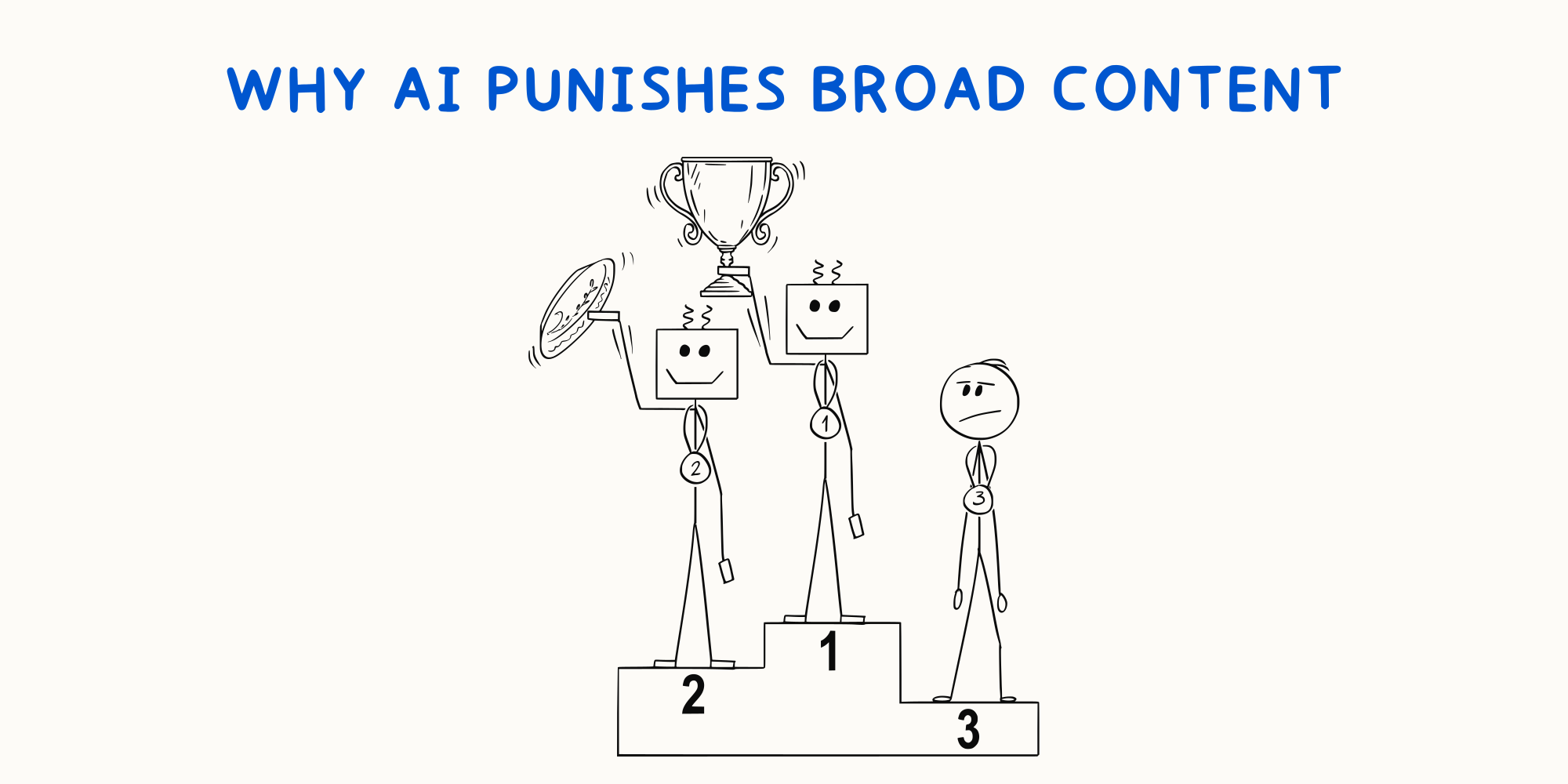
AI rewards depth. AI rewards expertise. AI rewards specificity.
And the businesses that specialise — deeply, confidently, repeatedly — are the ones rising while everyone else slowly drowns in a sea of sameness.
This article will show you why broad content fails in the AI era, the signals search engines now look for, and how to specialise in a way that leads to stronger rankings and better leads.
Why broad content is dying faster than anyone expected
AI hasn’t made content easier. It’s made the baseline higher.
Anyone can produce 1,000 generic words now. Anyone can write a passable intro. Anyone can summarise definitions that used to make up half the internet’s SEO playbook.
That means Google, Bing, and every other search engine has millions of almost identical articles on the same broad topics — most written in the same tone, using the same structure, and offering the same empty advice.
Search engines don’t need more of that. They have enough.
So they’re doing what’s logical: rewarding content that stands out through clarity, expertise, and lived detail.
And punishing anything that could have been generated by someone who spent five minutes reading another post.
Here’s what’s actually happening under the hood.
1. AI can answer broad questions instantly
Search engines want to get users answers fast. Broad questions have clear answers. AI can write those answers instantly.
So instead of sending traffic to your website, the search engine summarises the basics and keeps the user on the results page.
That means your “What is…?” content never gets a chance.
2. Broad content signals low expertise
When you write about everything, search engines assume you’re strong in nothing.
AI models can now analyse:
- your entire site’s topical focus
- the patterns of your content over time
- whether your articles share nuanced, industry-specific knowledge
- whether you publish more noise than depth
Broad content sends the wrong message: “We don’t have a point of view. We’re trying to rank for anything.”
That’s why smaller sites with strong focus often outrank bigger sites with generalised content.
3. Broad content attracts the wrong traffic
Even if it ranks, broad content brings in the wrong people.
Traffic with no intent. Readers with no urgency. People who will never buy anything.
Search engines notice this too. Low engagement. Low dwell time. No meaningful behaviour.
If your broad articles bring in the wrong crowd, the algorithm will assume your site doesn’t satisfy the right kind of searcher — and it pushes you down.
4. Broad content makes you easy to replace
If your article could be rewritten by ChatGPT in fifteen seconds, it’s going to lose to content that only a real expert could produce.
AI isn’t the threat. AI is the filter.
It filters out everything ordinary.
Why specialisation wins now
Search engines want depth. Buyers want depth. And AI rewards the sites that produce content with fingerprints — content that could only come from someone who actually does the work.
Specialisation does three things extremely well:
- It builds trust faster.
- It creates content only you can write.
- It matches real buyer searches far more closely.
When you specialise, your content goes deeper. Your examples get sharper. Your stories get more specific. Your explanations have texture instead of fluff.
That’s what AI can’t replicate.
That’s what search engines amplify.
And that’s what brings in the kind of organic traffic that actually converts — the buyer who already knows what the problem is and is now looking for someone who “gets it.”
How to specialise your SEO content (without boxing yourself in)
Specialising doesn’t mean writing the same thing over and over. It means choosing a lane and then going deeper than your competitors are brave enough to go.
Here’s how to do it.
1. Pick the problems your best customers actually want solved
Not the problems with the highest search volume. The ones with the highest commercial value.
Look at:
- the services that bring in your best customers
- the problems those customers complain about first
- the decisions they struggle with before buying
- the alternatives they compare you against
These are the topics you build around — not the broad definitions everyone else is writing.
2. Turn your expertise into patterns
Think about:
- the mistakes customers make before they call you
- what you always have to fix first
- the assumptions buyers get wrong
- the jobs that take the longest
- how experienced vs. inexperienced customers behave differently
These patterns become the fuel for content AI cannot replicate.
3. Write for buyers, not browsers
Specialisation isn’t just about choosing a niche. It’s about choosing the stage of the buyer you want to speak to.
Most businesses write content for beginners because it feels accessible. But beginners rarely buy.
Your strongest content should target:
- people comparing providers
- people choosing between solutions
- people who know the basics and want clarity
- people who’ve tried fixing it themselves and failed
That’s where conversion lives.
4. Narrow your topics until you’re the obvious choice
Broad topic: “project management tools.” Narrow topic: “project management for creative agencies.”
Broad topic: “accounting software.” Narrow topic: “accounting software for contractors who invoice weekly.”
Broad topic: “seo tips.” Narrow topic: “how small businesses can rank service pages faster than big competitors.”
The narrow angle creates authority. Authority creates trust. Trust creates leads.
What specialised content actually looks like
Specialised content is not longer content. It’s sharper content.
It sounds like:
- “Here’s what always goes wrong before clients hire us.”
- “The pattern we see in 90% of failed implementations.”
- “The reason most businesses choose the wrong tool first.”
- “Why our process removes the bottleneck nobody thinks about.”
This is the stuff buyers highlight, bookmark, send to colleagues, and quote on sales calls.
It’s the stuff AI cannot produce because it requires doing the work, not summarising it.
The shift that will carry you through the AI era
You don’t beat AI by writing more. You beat AI by writing what AI can’t touch.
You beat AI by specialising deeply. You beat AI by choosing real problems. You beat AI by showing your fingerprints in the content — the lived experience, the nuance, the patterns, the stories.
Broad content dies in the AI era because it asks nothing of you. Specialised content thrives because it asks everything.
And search engines can tell the difference instantly.
If you want organic traffic that turns into revenue, the path is simple:
Stop writing what everybody else is writing. Start writing what only you can write.
