The complete guide to local SEO

Written by Aggée Kimpiab
8+ years of SEO experience. Started out machining steel on the factory floor before moving into SEO. Now works with manufacturers, ecommerce brands, and B2B companies on organic growth. Case studies: Lawton Tubes and MoverX.
Table of Contents
Type plumber near me into Google and look at what loads before any website does. A map. Three listings with star ratings. Then, eventually, the blue links.
That’s local SEO’s entire argument in one search. For a huge share of local intent, the map pack gets seen first, and if you’re not in it, the organic result underneath barely matters.
This guide covers what actually moves a local business into that map pack and keeps it there, plus a checklist and a 60-second self-check near the bottom so you can see exactly where you stand before you read another word.
What local SEO actually is #
Local SEO is the practice of getting found by people searching for what you do, near where you are. That covers three overlapping result types: the local pack (the map and three-listing block), local organic results, and Google Maps itself.
It’s a different game to regular SEO. National SEO is a pure content-and-authority contest. Local SEO adds a location layer on top: your Google Business Profile, how consistently your business is listed across the web, and content that’s actually specific to where you operate instead of a template with the city name swapped in.
How local rankings actually work #
Google has said publicly that local ranking comes down to three factors:
Relevance. How well your business matches what someone’s searching for. A dentist ranks for dentist rather than family lawyer, no matter how well-optimised the profile is.
Distance. How far your business is from the location implied in the search, whether that’s a “near me” search or a specific area someone typed.
Prominence. How well-known your business is, both online and off. Review volume, review quality, citations, links, and general web presence all feed into this.
You can’t do much about distance, a searcher three miles away will usually beat you regardless of how good your SEO is. Relevance and prominence are where the actual work happens, and where the rest of this guide lives.
Practical tool
Which ranking factor should you work on?
Quick fix:
Google Business Profile: the highest-leverage piece #
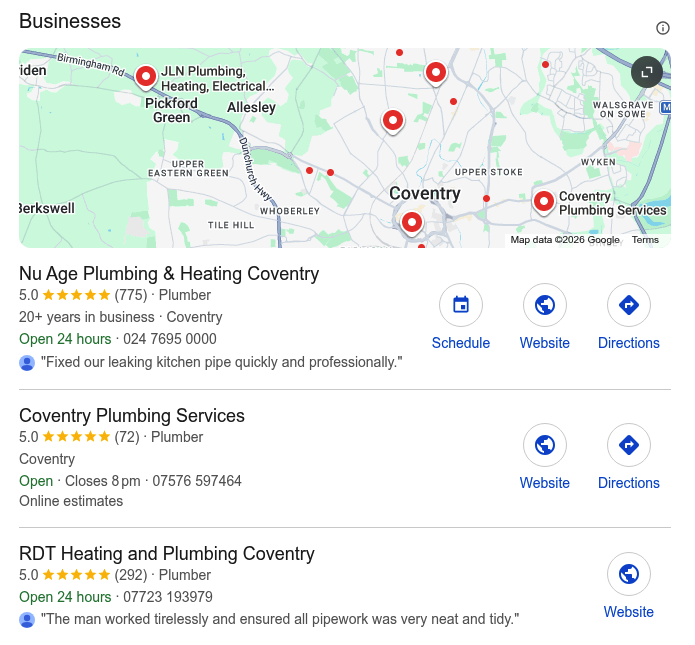
If you do one thing from this guide, do this. Your Google Business Profile (GBP) is the single biggest lever in local search, because it’s the thing Google is literally pulling the map pack listing from.
Claim and verify it. Obvious, but a meaningful number of businesses are still searching on an unclaimed or unverified listing.
Fill in every field. Categories, hours, service area, attributes, products or services, the works. An incomplete profile is a weaker signal than a complete one, and it’s also just worse for the person looking at it.
Get the primary category right. This one field has an outsized effect on what you rank for. “Plumber” and “Emergency plumber” are not the same category, and picking the wrong one can quietly cap your visibility for the searches that actually matter.
Add real photos, regularly. Stock images are obvious and unhelpful. Real photos of your premises, team, and work build trust with searchers and give Google more to work with.
Use posts and Q&A if you’ll actually keep them updated. An abandoned GBP post from 18 months ago is worse than no posts at all.
Practical tool
Which GBP field actually moves the needle?
NAP consistency and local citations #
NAP stands for Name, Address, Phone, and it needs to match exactly everywhere your business is listed: your website, Google Business Profile, Yelp, industry directories, your Facebook page, all of it.
Google cross-references these listings (called citations) as a trust signal. “123 High Street” on one directory and “123 High St.” on another might look the same to you. To an algorithm matching text strings, it’s a discrepancy, and enough discrepancies quietly undermine how confident Google is in your business details.
What to do:
- Get listed on the major directories relevant to your industry (general ones like Yelp and Bing Places, plus whatever’s specific to your trade)
- Audit what’s already out there. Old addresses, closed locations, and duplicate listings from a previous owner are more common than you’d think
- Keep it boring and consistent. The goal isn’t creative formatting, it’s an exact match
Practical tool
Spot the NAP inconsistency
Three listings for the same fictional plumber. Click the one that doesn't match the other two.
Local keyword research #
Local search behaviour has its own patterns that generic keyword research misses.
“Near me” and “in [city]” searches carry obvious local intent, but they’re often not the biggest volume. Plenty of local searches don’t include a location at all, Google infers it from the searcher’s location instead.
Service plus suburb combinations matter more than city-wide terms if you’re in a large metro area. “Roofer in Levenshulme” converts differently than “roofer in Manchester” for a business that only covers a few neighbourhoods.
Buyer-stage terms matter more locally than they do nationally. Someone searching emergency plumber near me is further along than someone searching how to fix a leaking tap, and your local pages should be built for the former.
Practical tool
Build a local keyword
On-page and technical local SEO #
LocalBusiness schema markup helps search engines parse your name, address, hours, and service area directly from your site’s code rather than inferring it from the page text.
A dedicated page per location. If you serve five towns from one storefront, or have five actual locations, each one earns its own page built around what’s actually true of that location rather than a copy-pasted template with find-and-replace on the town name.
Location and service in your titles and headers, stated plainly. This isn’t keyword stuffing, it’s just being clear about what the page is for.
Speed and mobile experience. A huge share of local search happens on a phone, often while someone’s moving. A slow site loses that visitor before they’ve read a word.
Service area pages, for businesses without a storefront #
Not every local business has a physical location customers walk into. Plumbers, electricians, mobile groomers, cleaning companies, most trades travel to the customer instead.
Google Business Profile supports this directly, you can set a service area instead of (or alongside) a physical address. Your website should mirror that: dedicated pages for each area you actually cover, built around real local detail (typical call-out times, area-specific problems, local landmarks that prove you actually work there) instead of a generic page cloned across twenty towns with nothing but the name changed.
The mistake I see most often here is exactly that cloning. Google can tell, and so can anyone who lands on two of your pages back to back.
Reviews and reputation #
Reviews feed directly into the prominence factor, and they’re also the first thing most people actually read before calling anyone.
Ask for them, consistently. Happy customers rarely leave reviews unprompted. A simple ask, right after a good outcome, is the single best lever most businesses aren’t pulling.
Respond to all of them. Good and bad. A thoughtful response to a negative review often does more for trust than another five-star one, it shows a real business is paying attention.
Don’t gate or buy them. Filtering out unhappy customers before they can leave a public review, or paying for reviews outright, violates Google’s policies and risks the listing entirely. It’s not worth the risk.
Practical tool
Weak reply vs. strong reply
★★☆☆☆ · Dana R.
Booked an emergency call-out and no one showed up in the two-hour window we were given. Had to call twice just to get an update. The work itself was fine once someone actually turned up.
Local link building #
Most local link building advice defaults to directory submissions, and while citations matter (see above), genuine local links carry more weight and are more durable.
Real options that actually work:
- Local press: a genuinely useful comment, a local business milestone, or sponsoring something newsworthy can earn coverage from local news sites
- Chamber of commerce and local business associations, often an easy, legitimate link
- Sponsorships: local sports teams, community events, charity drives, most will link back
- Supplier and partner sites: if you supply or work with other local businesses, ask if a mention is possible where it’s genuinely relevant
The pattern across all of these: the link exists because of a real, verifiable local connection, never because it was bought from a directory that exists purely to sell links.
If you have more than one location #
Multi-location SEO is its own discipline, dedicated pages per location, a consistent template that still allows for real local detail, and Google Business Profiles managed individually rather than as an afterthought. I’ve written a fuller breakdown in how to do local SEO for multiple locations if that’s your situation.
Common local SEO mistakes #
One page trying to represent every location. Covered above, but it’s the single most common mistake I see.
Inconsistent NAP data left over from a rebrand, a move, or a previous owner, still floating around on old directory listings.
Treating Google Business Profile as a one-time setup instead of something that needs occasional attention, new photos, updated hours, responses to new reviews.
Chasing citations while ignoring content and links. Citations are foundational, but content and links are what actually move rankings.
Local SEO checklist #
Eighteen items, grouped by category. Check them off as you go, your progress is saved in your browser so you can come back to this later.
Practical tool
0 / 18 done
Google Business Profile
Citations
On-page and technical
Reviews
Content
Links
60-second self-check #
Answer honestly. This runs entirely in your browser, nothing is sent anywhere.
60-second self-check
How strong is your local SEO right now?
If working through this raised more questions than it answered, that’s normal, local SEO has a lot of moving parts. Get in touch and I’ll give you a straight answer about where your specific situation stands, or look at what local SEO help looks like if you want to see how I approach it.
Related reading: How to do local SEO for multiple locations · What Google’s AI changes mean for local SEO · SEO for roofing companies · SEO help, wherever you’re based · SEO in Daventry · SEO help in Manchester