Blog content vs. category pages: which one should actually rank?

Written by Aggée Kimpiab
8+ years of SEO experience. Started out machining steel on the factory floor before moving into SEO. Now works with manufacturers, ecommerce brands, and B2B companies on organic growth. Case studies: Lawton Tubes and MoverX.
Table of Contents
Here’s a failure mode that’s specific to ecommerce sites. It doesn’t really happen on content-only sites. A blog post and a category page both end up targeting the same commercial keyword. Instead of one of them ranking well, Google can’t decide between them. Sometimes it ranks the weaker page. Sometimes it rotates between both. Sometimes it ranks neither where it should be.
This is keyword cannibalisation. On ecommerce sites it’s usually self-inflicted by exactly the advice that’s supposed to help: “write more content targeting your key terms.”
Why this happens specifically on ecommerce sites #
Picture a content marketer, understandably wanting to build topical authority, writing “Best hiking boots for 2026” as a blog post. It covers roughly the same ground as the store’s existing /hiking-boots/ category page, and targets roughly the same keyword. Now both pages are quietly competing for the same search intent, the same term.
Google doesn’t reward having two attempts at the same keyword. It has to choose one to show, and that choice fragments whatever ranking signal (links, clicks, engagement) would otherwise have concentrated on a single page. The result: both pages usually end up performing worse than either would have alone.
The test: which page type should own a given keyword #
Category page territory
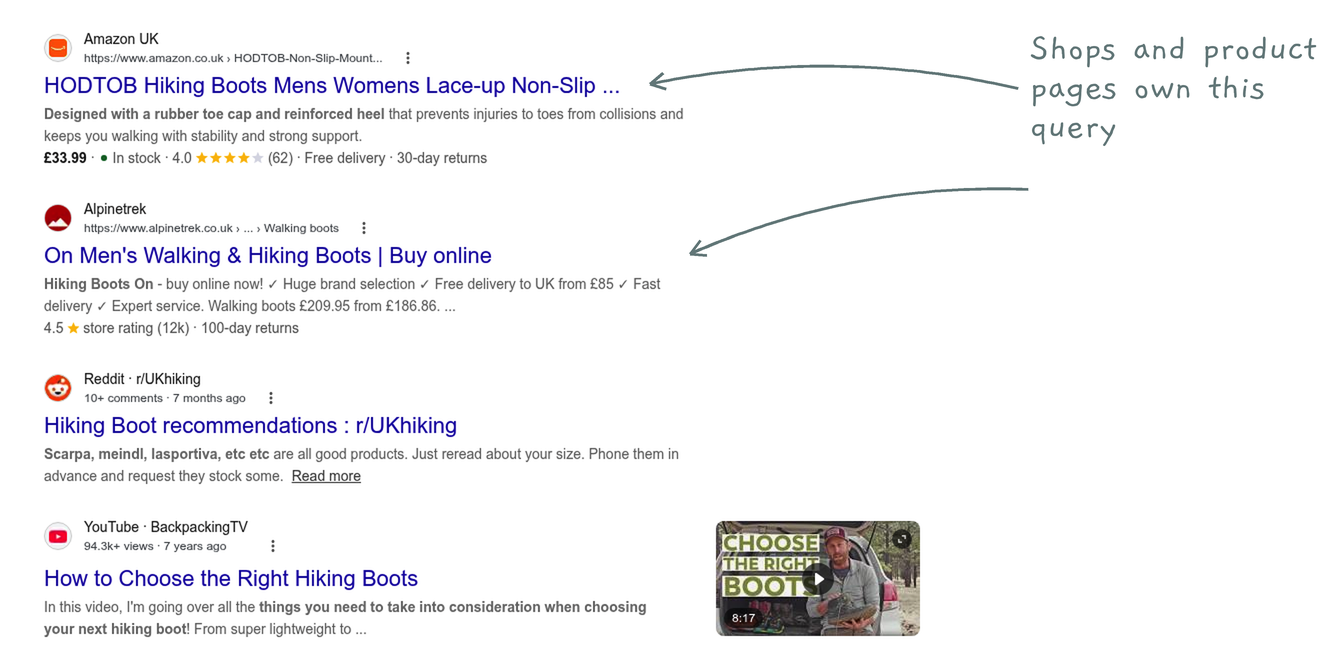
The keyword itself implies "show me the products": "hiking boots," "waterproof hiking boots," "men's hiking boots size 10." A shopper typing this wants a product grid up front, with 2,000 words to read the last thing on their mind.
Blog content territory
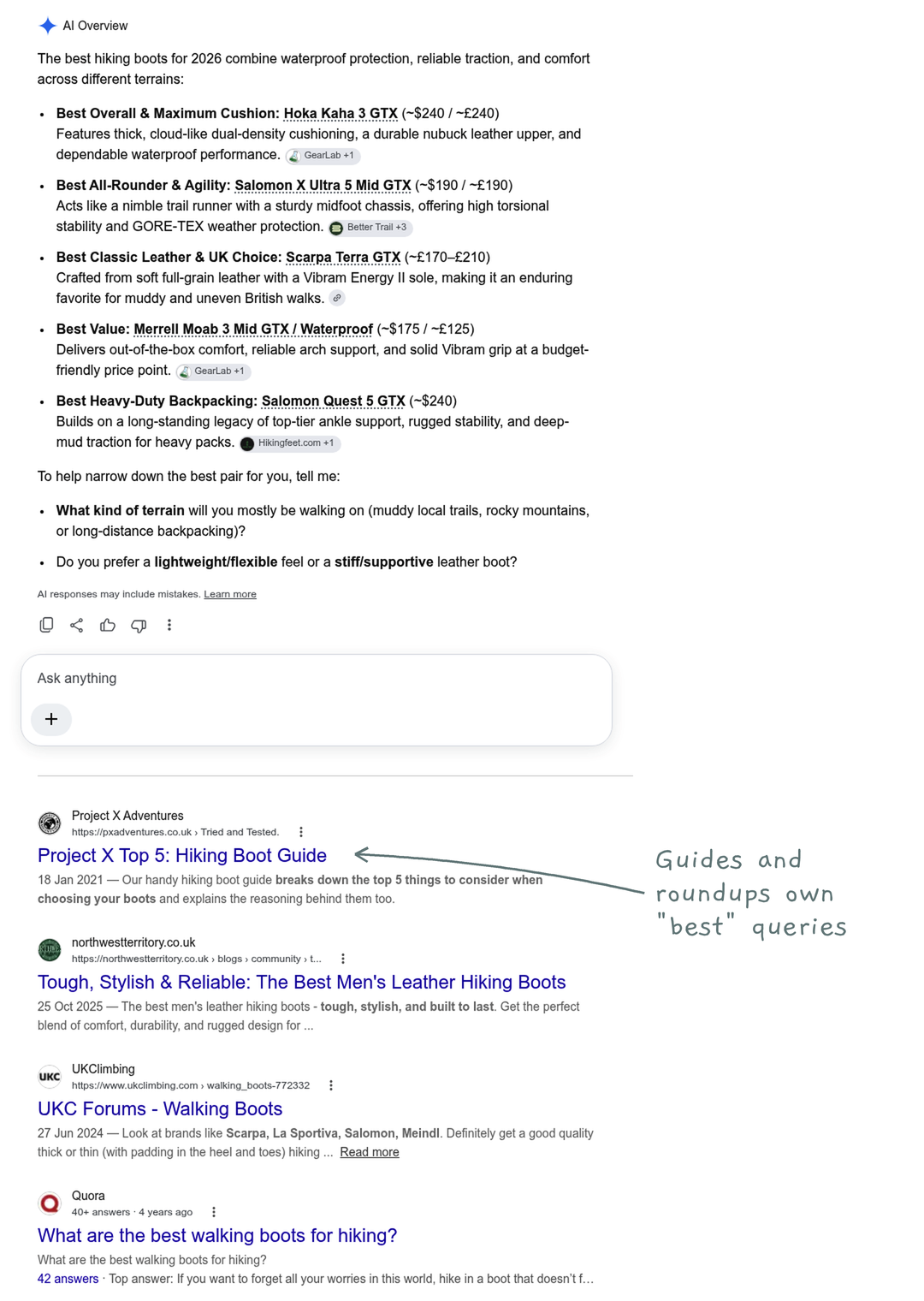
The keyword implies "explain this to me": "how to choose hiking boots," "hiking boots vs trail shoes," "how to break in new boots." A shopper typing this wants an answer, then a path to relevant products.
If you genuinely can’t tell which bucket a keyword belongs in, check what’s already ranking for it in Google. A page of product grids means commercial or category intent is winning. Guides and articles up there instead? That means informational or blog intent has the edge. It’s a direct, current signal, grounded in what’s actually ranking, for which page type has a real shot at that specific term.
That’s the same intent-bucket thinking covered in more depth in ecommerce keyword research, just applied here to one specific, recurring conflict.
Fixing it where it’s already happened #
If an audit turns up existing cannibalisation, a blog post and a category page both ranking poorly for the same term, the fix is consolidation instead of more content:
Step 1
Decide which page should win based on the intent test above. Usually that's the category page for anything with real commercial intent, since it's the page that can actually convert the visit.
Step 2
Re-angle the losing page toward a genuinely different keyword instead of deleting it outright. A "best hiking boots" post can become a "how to choose hiking boots" guide, shifting it from competing with the category page to feeding it.
Step 3
Link the re-angled content to the category page directly, so the internal link equity that used to be split between two competing pages now reinforces the one meant to rank.
Why this isn’t an argument against blog content #
None of this means ecommerce sites shouldn’t have blogs. Quite the opposite. It means blog content should target the roughly 70% of informational-intent search demand that a category page was never going to satisfy anyway, using that reach to funnel traffic toward category and product pages instead of duplicating what they already do. A blog post that links prominently to the relevant category page is doing its job. Try to out-rank that same category page for its own core term, though, and you’re working against the rest of your site.
The practical rule: one primary keyword, one page, decided in advance, rather than worked out after the fact once two pages are already quietly cannibalising each other.
Cannibalisation audits are a standard part of ecommerce SEO work here, precisely because it’s invisible until you’re specifically looking for two pages competing for the same term.
Related reading: Ecommerce keyword research · Category page SEO · Internal linking · Ecommerce SEO consultant